Book Review: The Joy Of Coffee

joy of coffee
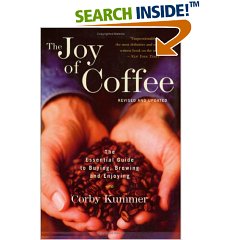
How does one even begin to describe the joys associated with this bean, this brew? I honestly don’t know! Perhaps the best way would to be go ahead and concoct your own brew and share it with friends as you lounge around on a lazy Saturday afternoon. Or maybe, you can get this book by Corby Kummer and give it as a gift!

The Joy Of Coffee: The Essential Guide to Buying, Brewing, and Enjoying has been around for quite some time now. It has been recently updated and revised, though, to keep up with the changing landscape of the world of coffee. This book is an easy read with roundabouts 300 pages. From the growing of the beans to buying to roasting, storing, and brewing – all of these things are presented by Kummer.

I like how Kummer pays attention to the minutest details in his book as he recounts his experiences over the past several decades. I think it is his unique and authentic experience and knowledge that gives his book an edge over the countless other printed materials on coffee available in the market today. In the book, Kummer also shares tons of recipes which the average person – like you and me – can try out at home. For me, that is one of the best aspects of The Joy of Coffee.

So what are you waiting for? You can get a copy on Amazon for only about $10. Alternatively, if you want a preview before getting your own copy, you can check out Google Book Search.

Preserving the Quality of Coffee Beans

The quality of coffee beans depends on how people would store them and be sensitive to the various forces that would allow it to lose its fine quality after harvesting. A good thing to note is that exposing these beans to open air contributes to losing its actual quality. This is why it has been a practice to keep coffee in tightly sealed containers so that people can consume them at any time they would wish.

Coffee Storage Vacuum

Storing them as well in cold temperatures, help retain its level of freshness. Freezing them is a good practice especially for coffee beans that are not immediately consumed and are meant for storing. This allows people to consume them at any time they wish wherever they are.

It should also be good to note not to place them beside aromatic food such as garlic and onions. Coffee beans absorb odors and once placed beside high aromatic elements, chances are that the coffee beans would solicit their smell.

Technorati Tags: , , ,

Craving for Ice Blended Coffee Frappuccinos

Blame it on Starbucks, but the craze that blended iced coffee with whipped cream and chocolate drizzles on top has signaled the obvious efforts by other coffee companies to indulge in such same coffee drink preparation that has been aimed for all ages. While coffee was never known to be suitable for children, the option of having them decaffeinated allows them to enjoy the coffee drink as well with some twists in flavor and presentation.

Starbucks Frappuccinos

While some would consider such drinks as fattening, it would depend on the product knowledge on what components of the usual blended coffee or familiarly known as “frappuccino”, made famous by Starbucks, has been a drink demanded by millions since its inception.

To date, it is an automatic identifying mark for people to relate such frappuccinos with Starbucks. They are usually available in coffee, mocha, caramel and Rhumba. The best way to see which the best is is to try them all out. But a word of caution, once a person enjoys his first order; don’t expect it to be the last!

Technorati Tags: , , ,

Love Nuts to Go with Coffee

Most pastry and donut companies such as Dunkin’ Donuts and Mister Donut would often offer creative designs for their line of delicacies to go with the occasion. In this case, the occasion of Valentines brings out such conceptualized promotions such as love donuts or smidgets, something that can be consumed by the normal consumer or made as an alternative for giving gifts on Valentines day.

Coming up with such season promotional gimmicks are only normal. People will always look towards promotions, giveaways and advertising tools that most establishments would resort to for them to gain attention and be a benchmark in adhering towards significant occasions such as Valentines.

Coffee and Donuts

Paired with coffee, pastries are the first thing that comes to mind when a simple sip of their favorite brewed concoction will be ordered. The wide array of coffee creations will surely need a partner in most cases, and the line of pastries may be very well be dependent on the seasonal offering such as that of the day of the hearts known as Valentines Day.

Technorati Tags: , , , , ,

Coffee Carts, New York Streets and A Beautiful Film

The foreign film everyone is talking about today is about coffee. Well, actually its the poingnant story about a Pakistani man who pushes a coffee cart around Wall Street.

Written and directed by Ramin Bahrani, an Iranian-American who also worked as a coffee-cart-man himself, prestigious film festivals all over the world are touting this atmospheric film as a firm favourite of the year.

The film focuses on the life of Ahmad, a Pakistani immigrant who pulls his coffee-filled quilted metal cart around the Wall Street environs from dawn. He serves his coffee to friendly “suits”, but the story takes shape when he befriends a customer who is a fellow Pakistani.

“Man Push Cart” has a haunting score, brilliant cinematography and a universal message which transcends the boundaries of class and culture.
And most importantly, it will make you wonder, the next time you are at a coffee shop or more appropriately, coffee cart - about the person pouring your cup of java. Hopefully, you’ll end up asking him yourself.

Coffee Books To Buy


We’re not talking coffee-table books here (although that does give me inspiration for a later post), but books specifically on the subject of - what else, coffee.

Yes, the internet is a great resource for information on absolutely everything (including coffee), but if you’re somewhat serious about learning more about the famous brew - from bean to cup, it makes good sense to arm yourself with some hard copies for your home library.

Here are some of the best recommendations we’ve found, from a site called “Coffee Search“. Each one was written by an industry pro, so rest assured you’ll be in good hands.

1. Coffee Basics : A Quick and Easy Guide by Kevin Knox.
Kevin Knox was the Specialty Coffee buyer for Starbucks, and he uses his experience to describe in precise detail how to prepare an excellent cup of coffee. Highly recommended for beginners.

2. Home Coffee Roasting: Romance & Revival by Kenneth Davids.
Comprehensive book about home roasting and why it can change the way you drink coffee. A must!

3. Espresso Coffee: Professional Techniques by David Schomer.
This book is currently the best book available for describing espresso preparation. Good for baristas or coffee shop owner.

4. The Devil’s Cup: Coffee, the Driving by Stewart Lee Allen.
The history of coffee in an entertaining way. Highly recommended to anyone who wants to cultivate their understanding of coffee’s influence on history.

5. Uncommon Grounds: The History of Coffee by Mark Pendergrast.
An excellent book about coffee history and the coffee market, more relevant to modern history.

6. The Coffee Book: Anatomy of an Industry
Another great introductory books about coffee history. Easier to read than Uncommon Grounds, with very useful information.

7. Coffee: Recent Developments by R. J. Clarke (Editor), O. G. Vitzthum (Editor).
Highly scientific and is recommended only for coffee professionals and scientists.

8. Coffee Flavor Chemistry by Ivon Flament.
A fascinating book detailing many of the chemical constituents found in coffee and their influence on flavor and aroma.

The Ultimate

chocolate-beans.GIF

While waiting for my movie date, I visited The Coffee Bean and Tea Leaf coffee shop. It wasn’t really much of a shop. It was more like an expanded stall with some tables and chairs. Still the place was warmly lit and looked inviting.

There was a very pleasant lady standing behind the counter named Che. Looks like she knows her coffee lovers very well. She took one look at me and when asked what she would recommend, she suggested I have the Ultimate Ice Chiller. My love of cold coffee must have been sticking out a mile.

What goes into an ultimate? Chocolate roasted coffee beans, mocha or vanilla flavor, milk, ice and cream. This is definitely not a drink for people watching their calorie intake. It is smooth, delicious and absolutely sinful.

When I asked about the process, she said she couldn’t disclose the recipe but she did show me the coffee beans. Chocoholics will love these beans! When Che said chocolate roasted coffee beans the last thing I expected to see was a box full of yummy looking chocolate coated coffee beans. We bought some to eat aside from the Ultimate.

The taste of the coffee is rather overpowered in this drink by the many flavors added. It is a delicious drink that will be much enjoyed by those among us who love to combine chocolate and coffee, with chocolate being the dominant flavor. Think of this as dessert.

If you’re near a Coffee Bean and Tea Leaf try it out. I hope you get attended by a manager as nice as Che who makes this coffee place worth visiting again.

When Ordinary Coffee Just Won’t Do

bluejamaicanwhole300.jpg

It is quite common to hear people go: “coffee?” at least once a day. Even if they don’t say it out loud, they are bound to find themselves with a cup or mug in their hand savoring either the smell or the taste of the brew. Even those of the population who say that they don’t drink coffee have been to a coffee shop and enjoyed the rich scent that permeates the shop while chatting with their friends.

There are so many varieties to choose from. There are so many varied tastes and textures to coffee that it can be hard to decide which one is perfect. So far though, I have yet to hear anyone disagree that Jamaica’s Blue Mountain Coffee is delicious.

The Blue Mountains are a range of hills on the eastern side of the Jamaican island. The coffee is grown just below 5,500 feet where nature has created a wonderful home for the coffee plants. They are grown just below the forest reserve. The combination of the terrain, the rainfall and the Blue Mountain mist combine to create beans that make the base for a wonderful brew that has a taste so clean it is sweet. It is smooth rich and just absolutely perfect!

If you can’t decide what to get your best friend for her birthday and she lives on coffee, you won’t go wrong if you choose to get her some Blue Mountain coffee as a gift. There is a limited amount available since unlike most, these beans are not grown by plantations but by small area farmers. Its rarity is partly why it is such a treasure. Try some for yourself!

Capresso C1300 Espresso Machine

cp100

Capresso is very well known for the ability to produce great coffee and espresso machines. The C1300 comes with many features such as Capresso’s Claris Water Care System, built-in automatic milk frothing system, separate funnel allowing use of pre-ground coffee, 6 temperature selections for water and coffee, self-cleaning system, and auto shut-off.

Multi-function Digital Display

The C1300 features a bright blue backlit digital display; providing a lot of information about the machine’s status, beverage selection, language, water temperature, cleaning indicators, auto-off times, and counter and machine statistics. Also, the display will show status messages of; Warming Up, Steam, Hot Water, Rinsing, Fill Water, and Empty Tray.

Adjustable Coffee Dispensing Nozzle

You can place anywhere from a small 2 ounce cup to a large 12oz depending on the height and size of your coffee cup.

Thermo Block Heating System

The built-in boiler is powered by 1450 watts; this allows use for a large numbers of servings within short time periods.

Professional Built-In Grinder

A professional built-in quality burr grinder accompanies the C1300. The “Conical” burr grinding mechanisms are heavy duty and are usually found on expensive grinders. Furthermore, the heavy duty grinding wheel is made of tempered steel, providing a long service life.

64 Ounce Built-in Water Tank

The built-in water tank holds enough water to produce about 40 espressos. Refilling the water tank is easy; this can be done by adding water while the machine is on.

Coffee Extraction

The C1300 has a maximum pressure output of 18 bars, which allows excellent coffee extraction.

Coffee Bean Storage

The built-in coffee bean hopper can hold 8 ounces of coffee beans, while keeping the coffee beans fresh at the same time.

Automatic Cleaning System

The C1300 features Automatic cleaning cycle indicator, which prevents coffee oil build-up in the brew chamber. The machine will remind you automatically after approx. 200 cups of coffee when it’s time to clean itself.

Hawaiian Coffees 2006: Not This Year

hawaiian

Disappointment implies history. We can only be disappointed if past successes make us expect more good things than actually come our way in the present. Such is the case with the latest revisiting of Hawaiian coffees.

First disappointment: A rather lackluster collection of coffees from the famous Kona growing region, with only one of the twenty-two 100% Kona samples we collected attracting a rating of 90 or better: the Bayview Farm 100% Kona Peaberry Medium Roast at 92. (When we cupped Konas in February of 2002 the average was considerably better.) Three dubiously named “Kona Blends,” which typically contain only 10% actual Kona coffee, were even less inspiring, though one Kona-style blend, the Surf City Hawaiian Blend (20% Kona) impressed with a rating of 91.

Second disappointment: Virtual disappearance from the mainland market of “other island” Hawaiis, those often interesting coffees produced by large, innovating farms on other islands outside the famous Kona growing district.

The Kona Disappointment

Kona bashers, those coffee professionals who resent Konas for what they feel is a disconnect between Kona’s very high prices and (for them) ordinary cup, will doubtless feel justified by this month’s results.

But I’m not a Kona basher. I enjoy the classically delicate, cleanly fruity, floral Kona cup, and I admire the passion, tradition and backyard creativity of the many small Kona growers. And as far as price goes, I would prefer that other growers in the world get paid more for their coffee than Kona farmers getting paid less.

Perhaps we simply sourced the wrong Konas. Or perhaps Kona had a bad year, as coffee-growing regions often do, although we hear it was a good one. Or, and I hope this last is not the case, some Kona mill owners and growers are not paying as much attention to detail as they once did.

Delicacy and Purity

At its best, the Kona cup is neither dramatic nor distinctive: It is quietly classical. Most Konas come from a variety of arabica with a deep connection to Central America: the “Guatemala” strain of typica. Typica is respected for its long and famous history, but it does not produce a flashy cup, either in Central America or in Kona. Nor are most Konas arresting in their acidity, although some from higher altitude farms produce an acidy cup with high-grown character.

All of which points to a delicate cup, the floral-fruit character of which requires the purity and sweetness that come from impeccable fruit removal and drying. Unfortunately, about half of the Kona samples we cupped for this article displayed problems that interfered with the subtle potential of the coffee - either astringency (too much unripe fruit?) or a dulling, musty shadow that could come from a couple of sources, but most likely from moisture-interrupted drying procedures.

One Perfect Example

We did source one example of what I would regard as a virtually perfect Kona, the 92-rated Bay View Farm peaberry. The Pele Plantations Pau Hana Estate Captain Cook (88) also was impressive, but for some reason stiffened and simplified a bit as it cooled.

Both Bay View Farm and Pele Plantations are Kona-based producers who roast and retail the best of their coffees themselves and sell direct to consumers. Such companies remain the best source for the finest Konas, although the normally excellent Hawaii-based Kona Blue Sky company and its associated farm, the Twigg-Smith estate, sent us several coffees that all, to one degree or another, exhibited shadow processing faults.

The Imitations Were Worse

Of course, Kona can’t be blamed for the indifferent quality of the three Kona Blends we sourced, given that these deceptions probably contain only 10% Kona. Whatever failure or success these blends achieve is the responsibility of roasting companies and their blend designers. Aside from the excellent Hawaiian Blend from Surf City, the Kona blends we sampled suggested that these companies tossed whatever vaguely low-acid wet-processed coffees they had around the warehouse into their faux Konas without much real commitment to approximating the subtle Kona character.

And Elsewhere on the Islands

Finally, the “other island” disappointment, although here there were some surprising and interesting new developments.

Some years ago, Hawaii officials and agricultural interests were taken with the possibility of shifting several of Hawaii’s economically unviable sugar and pineapple farms to the production of high-end coffee. These new farms were established on the basis of considerable research and study. At one time, four such farms were in operation, one each on the islands of Kauai, Oahu, Maui and Molokai. All embodied interesting coffee experiments. The farms on Molokai and Maui in particular produced distinctive and gradually improving coffees.

However, consumers apparently were not willing to pay Kona prices for non-Kona Hawaiian coffees, even if they were interesting coffees, and Hawaii’s very high labor costs apparently doomed three of these brave new coffee experiments, those on Oahu, Maui and Molokai.

The giant Kauai Coffee farm stayed in business mainly by switching to large-volume industrial production of “price” Hawaiian coffees, with a few higher quality “reserve” selections. One sample of Kauai Coffee did turn up for this month’s cupping, roasted by a mainland company. Regrettably, it was faded and baggy (mildewed with the ropey taste of the coffee bag). I would guess (hope?) that the “reserve” coffees available directly from the Kauai Coffee company itself at www.kauaicoffee.com are considerably better.

Revived Kaanapali Moka

But arguably the most interesting story is the surprising revival of the all-but-abandoned farms on Maui and Molokai under new ownership. Kaanapali Estate on Maui has been resuscitated in smaller and leaner form, and the Coffees of Hawaii farm on the rustic “Friendly Island” of Molokai will produce its first new crop under fresh management in 2006/07. Both of these farms produced some attractive coffees under their old regimes, and hopefully will again.

For this month’s exercise were able to source one coffee from the revived Kaanapali Estate, the Maui Mokka from roasted by Supreme Bean. The original Kaanapali estate produced four different botanical varieties of coffee, the most unusual being Moka (also Mokka, Mocca or Mocha), from trees of an exotic cultivar first commercialized hundreds of years ago in Yemen and apparently brought to Maui via research farms in Brazil. In years past, the Moka’s tiny, split-pea-like beans fascinated coffee aficionados, as did its Afro-Arabian fruit-and-chocolate cup character.

The sample of revived Moka roasted by Supreme Bean appears to have been processed by the ancient “dry” method, meaning the seeds or beans were dried inside the fruit, rather than after the fruit residue was removed (the “wet method”), as is the case in Kona and all but a handful of the world’s leading fine coffee regions. Unfortunately, with this month’s sample the fruit appears to have fermented heavily during drying, contributing a wildly winy fruit character that some adventurous coffee lovers may find attractive and others distasteful.

Nevertheless, it is wonderful news for aficionados that the Kaanapali fields, a living treasure of coffee research, are back in operation. I suspect that once this farm gets rolling it should send us some interesting and outstanding coffees, as should the revived Coffees of Hawaii farm on Molokai.

Next Page »